

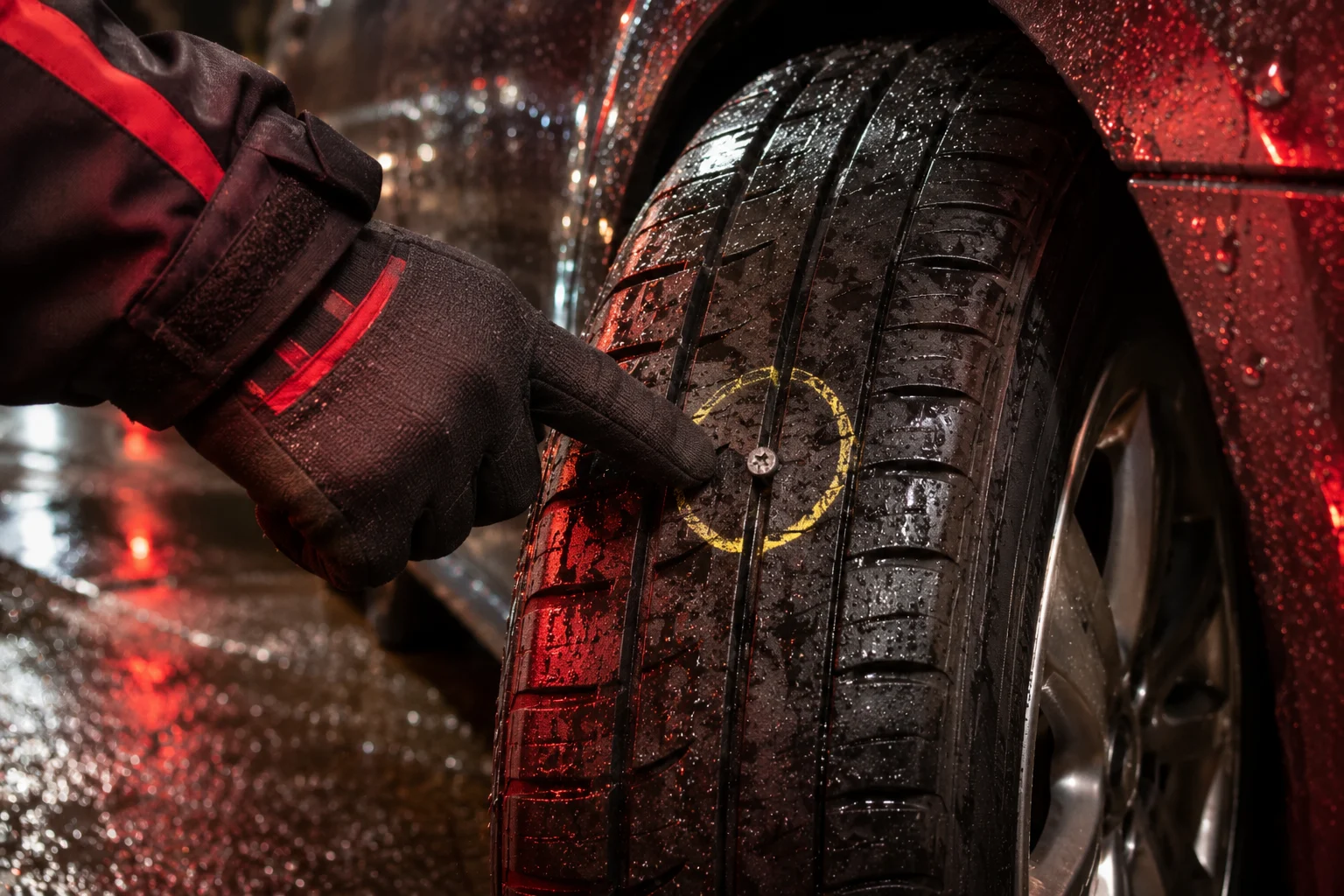
You have found a nail in your tyre, or the pressure warning keeps coming on every few days. The big question is whether a puncture repair will do, or whether you need a brand-new tyre. In the UK the answer is set by the British Standard BS AU 159, which every reputable fitter follows. This guide explains the rules in plain terms, with the situations we see most often on driveways and roadsides around Yorkshire.
The short answer
A car tyre can usually be repaired if all of these are true:
- The damage is in the central part of the tread – roughly the middle three-quarters of the tyre’s width.
- The hole is no bigger than 6mm across – typical of a nail or a screw.
- The tyre has not been driven while flat or badly under-inflated.
- There is no other damage – no bulges, cuts, exposed cords or a previous repair in the same spot.
- The tyre still has legal tread left – there is no point repairing a tyre that needs replacing anyway.
If any one of these fails, the safe answer is a new tyre.
What is BS AU 159?
BS AU 159 is the British Standard for repairing car and van tyres. It defines where a tyre may be repaired, how large the damage can be and how the repair must be done. A tyre repaired properly to BS AU 159 can carry on at its original speed and load rating for the rest of its life. Most major tyre retailers, including Kwik Fit, base their puncture repair policy on it.
The minor repair area
The tread is split into zones. Only the central zone – the minor repair area – can be repaired. The shoulders and the sidewalls flex the most and carry the load, so a repair there could fail at speed. That is why a screw just 2cm too close to the edge can turn a cheap repair into a replacement.
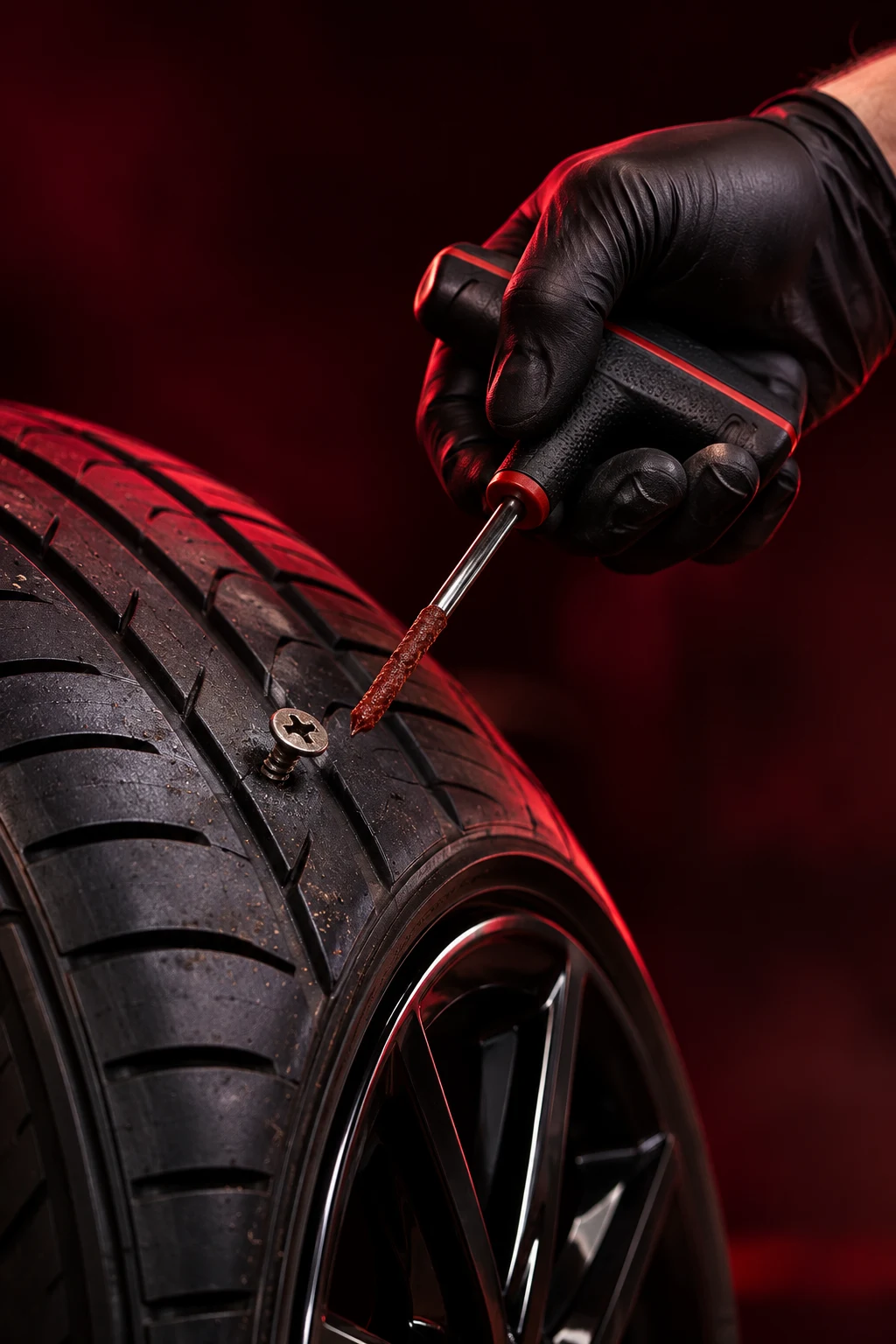
How a proper puncture repair is done
- Find and mark the damage. The fitter checks the tread and sidewalls and marks the hole.
- Remove the tyre from the wheel. This step is essential. Only from the inside can you see whether the liner was damaged by running flat.
- Inspect the inside. Rubber dust, creases or a shiny band around the inside wall mean the tyre was run flat – it cannot be repaired.
- Clean and prepare the hole so the repair bonds properly.
- Fit a combination plug-and-patch from the inside. The plug fills the hole; the patch seals the inner liner.
- Refit, balance and inflate the tyre to the correct pressure, then torque the wheel nuts.
A string plug pushed in from the outside without removing the tyre is a temporary fix at best. It does not meet BS AU 159, because nobody has checked the inside of the tyre.
When a puncture cannot be repaired
- Sidewall or shoulder damage – too close to the edge, whatever the size.
- Holes larger than 6mm or long cuts and splits.
- Run-flat damage – the tyre was driven while flat.
- Overlapping repairs – a repair cannot be placed over or next to an earlier one.
- Bulges, exposed cords or impact damage from a pothole or kerb.
- Worn-out tyres – at or near the legal limit (see legal tyre tread depth in the UK).
Many fitters, us included, take a cautious line with high speed-rated tyres and tyres that have already been repaired once. If in doubt, we show you the damage and explain why.
Signs of a slow puncture
- One tyre looks lower than the others in the morning.
- The TPMS warning light comes on every few days.
- The car pulls slightly to one side.
- You keep topping up the same tyre at the petrol station.
A slow puncture is the best kind to catch – deal with it early and it is usually repairable. Leave it, and the tyre may end up driven flat.
What about sealant kits?
Many new cars come with a sealant and compressor kit instead of a spare wheel. It can get you home with a small tread puncture, but the sealant has to be cleaned out before a proper repair. Always tell the fitter you have used one. Sealant will not fix a sidewall cut or a blowout.
Run-flat tyres
Run-flats are a special case. Some makers allow a repair under strict conditions, but many fitters will not repair them because it is hard to know how far the tyre was driven after losing pressure. Read more in run-flat tyres explained.
Repair or replace: how much difference does it make?
A repair costs a fraction of a new tyre, which is why we always check first. If replacement is the only safe option, we tell you the fitted price for a matching tyre before any work starts. Our mobile tyre fitting cost guide shows what affects the price.
Tips to protect your tyres
- Check your tyres once a month – look for screws, nails and cuts.
- Keep pressures at the figures in your handbook.
- Stop as soon as you suspect a flat – do not drive on it.
- Avoid kerbing and slow down for potholes.
- Replace tyres in pairs on the same axle for balanced grip.
Puncture repair at your door in Yorkshire
We carry out BS AU 159 puncture repairs at your home, workplace or a safe roadside spot in Leeds, Bradford, Wakefield, Sheffield, York and across Yorkshire. If the tyre cannot be repaired, we can fit a brand-new one there and then. Send a photo of the damage on WhatsApp or call 07000 000 000. See all our mobile tyre services.