

The legal tyre tread depth in the UK is one of those rules most drivers half-remember. Is it 1.6mm or 2mm? Is it the whole tyre or just the middle? And how much trouble are you in if the police find a bald tyre? This guide answers all of it, explains how to check your tread in two minutes on your driveway, and when we would actually recommend replacing your tyres – which is earlier than the law requires.
What is the legal tyre tread depth in the UK?
For cars, light vans and trailers up to 3,500kg, the legal tyre tread depth is 1.6mm across the central three-quarters of the tread, around the entire circumference of the tyre. In other words, it is not enough for one patch to be legal – the whole band around the middle of the tyre must be above 1.6mm. The outer quarter (the shoulders) is not part of the measurement, but it still must not be bald or damaged.
What happens if your tread is below the limit?
According to the RAC, driving on tyres below the legal limit can mean a fine of up to £2,500 per illegal tyre and penalty points on your licence. Four illegal tyres could add up to fines of £10,000. On top of that:
- Your car will fail its MOT.
- Your insurance may be invalidated if you have an accident on illegal tyres.
- Your stopping distances in the wet get noticeably longer as the tread wears down.
How to check your tread depth
1. Use a tread depth gauge
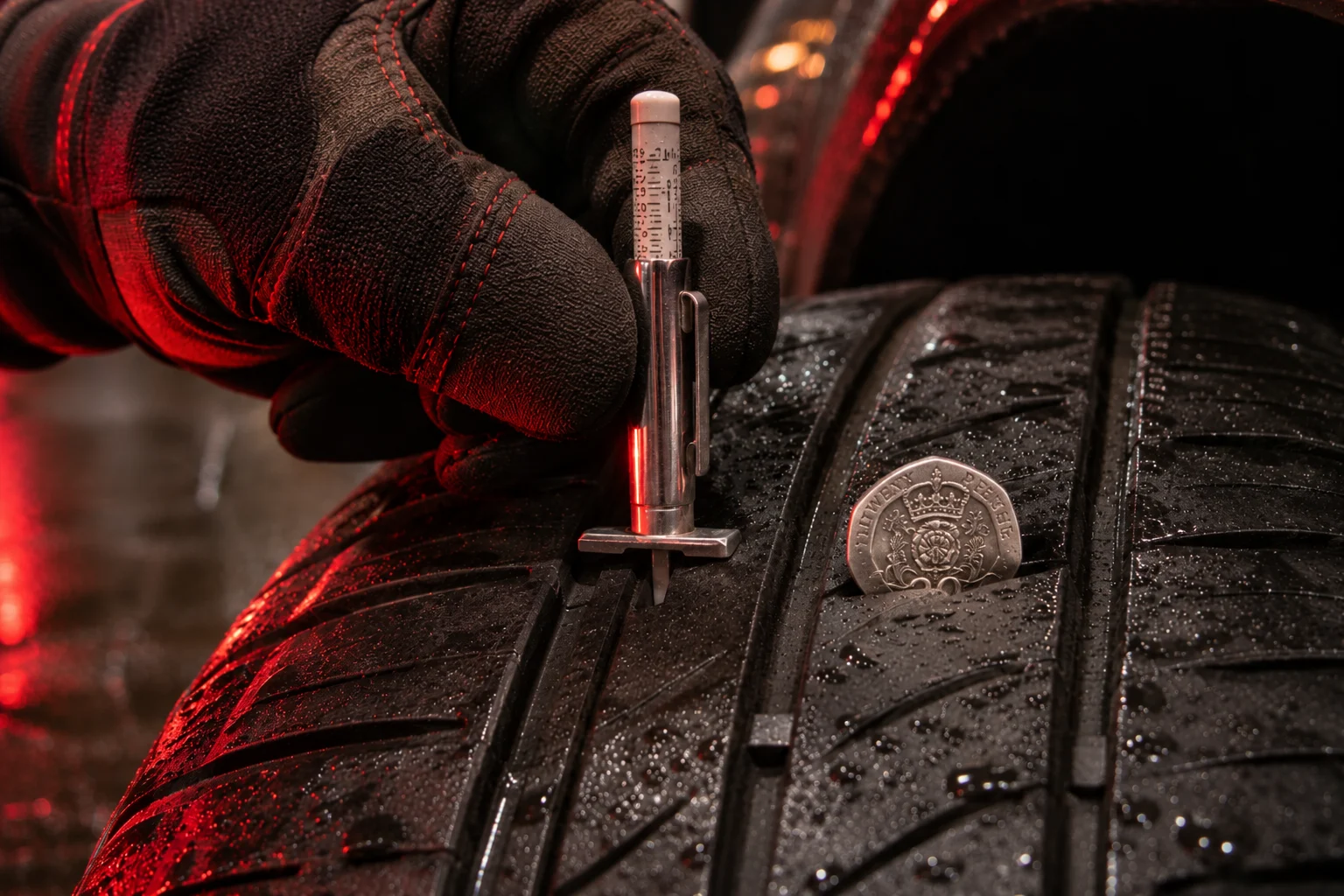
The most accurate way. A simple gauge costs a few pounds. Push the pin into the main grooves in at least three places across the tyre and at several points around it. Write down the lowest reading.
2. Look for the tread wear indicators
Every car tyre has small raised bars across the bottom of the main grooves, set at 1.6mm. If the tread surface is level with those bars, the tyre is at the legal limit and must be replaced. Look for a small triangle or the letters TWI on the shoulder – they show where the indicators are.
3. The 20p test
Put a 20p coin into the main tread grooves. If you can see the outer band of the coin, the tread may be close to or below the limit – get it checked with a gauge straight away. Repeat at several points around the tyre, because tyres often wear unevenly.
Why we recommend replacing at 3mm
1.6mm is the legal minimum, not a safe target. Many safety experts recommend changing tyres at around 3mm, because:
- The grooves clear far less water at low tread depth, so the risk of aquaplaning rises quickly in heavy rain.
- Braking distances in the wet get longer as the tread wears.
- Thin tread is easier to puncture.
For Yorkshire’s wet winters, high Pennine roads and fast stretches of the M1, M62 and A1(M), that extra margin matters. See our guide to winter vs all-season tyres for the cold months.
Other things that make a tyre illegal
Tread depth is not the only rule. A tyre can also be illegal if it has:
- A cut longer than 25mm or 10% of the tyre’s width, deep enough to reach the cords.
- A lump, bulge or tear caused by damage to the internal structure.
- Any exposed ply or cords.
- The wrong size or type for the vehicle, or a mix of tyre types that is not allowed on the same axle.
- Pressures that are not suitable for how the vehicle is being used.
A bulge in the sidewall is a sign of internal damage – usually from a pothole or a kerb. It can fail suddenly, so replace the tyre as soon as you see one.
Is there a legal age limit for car tyres?
There is no legal age limit for car tyres in the UK. Since February 2021, though, tyres older than ten years have been banned from the front steered axles of lorries, buses and coaches, and from single rear wheels on minibuses. For cars, rubber hardens and cracks with age even when there is plenty of tread left – especially on cars that sit unused. You can find the manufacture date in the four-digit code on the sidewall: 2319, for example, means week 23 of 2019. Ask a fitter to check any tyre that is getting on in years.
How long do tyres last?
It depends on your driving, your car and the tyre. Front tyres on front-wheel-drive cars usually wear faster than the rears. Heavy cars, especially EVs, can wear tyres more quickly – see EV tyres explained. Uneven wear on the inside or outside edge usually points to a wheel alignment problem, which a garage can fix.
Replace in pairs
When one tyre is worn, its partner on the same axle is usually close behind. Replacing tyres in pairs keeps grip and braking even from side to side. If you are only replacing two tyres, most tyre makers recommend fitting the newer tyres on the rear axle for stability in the wet.
Need new tyres before your MOT?
We fit brand-new tyres at your home or workplace anywhere in Yorkshire – often the same day – so you are never driving around on illegal tyres waiting for a garage slot. Not sure which tyre to choose? Read budget vs premium tyres, then send your tyre size on WhatsApp or call 07000 000 000. Our price guide explains what is included.