

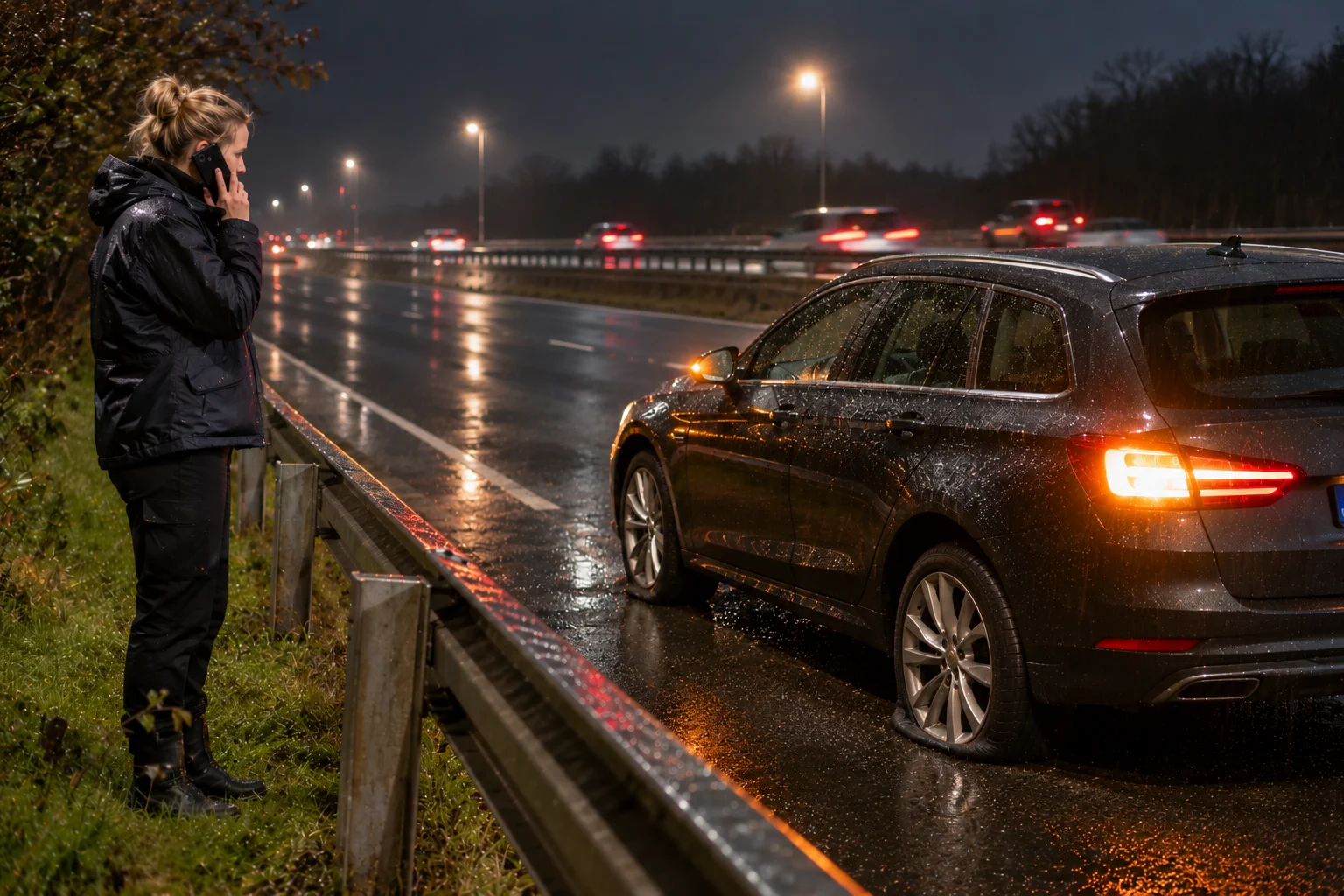
A flat tyre on the motorway is frightening. One moment you are cruising along the M62 or the M1, the next the steering goes heavy, there is a thumping from one corner and lorries are thundering past. What you do in the next two minutes matters far more than the tyre itself. This guide walks you through it step by step – first getting safe, then getting the tyre sorted – with notes for the motorways we cover across Yorkshire.
Signs you have a flat tyre on the motorway
- The car pulls to one side and the steering feels heavy or vague.
- A rhythmic thumping or flapping noise that gets faster with speed.
- Vibration through the steering wheel or the seat.
- A tyre pressure warning light (TPMS) on the dashboard.
- A loud bang followed by the car squirming – usually a blowout.
If it is a sudden blowout, do not brake hard. Hold the steering wheel firmly, ease off the accelerator and let the car slow down in a straight line before you steer gently to the left.
Step 1: Go left
National Highways’ advice is simple: go left. Put your left indicator on and move into the left lane. Then, in this order of preference:
- Leave at the next junction or pull into a motorway service area if you can do so safely. This is by far the best place to deal with a flat tyre.
- Use an emergency area on smart motorways without a hard shoulder. They are marked with orange signs and have an SOS phone.
- Stop on the hard shoulder if there is one, as far to the left as possible, with the wheels turned slightly towards the verge.
Driving slowly on a flat tyre will probably ruin it. That does not matter. A tyre can be replaced – getting out of a live lane is what counts.
Step 2: Make yourself visible and get out on the left
- Switch on your hazard warning lights straight away.
- If it is dark or visibility is poor, keep your sidelights on.
- Get everyone out through the left-hand doors, away from traffic.
- Climb over the crash barrier if it is safe and wait up the bank, well away from the car.
- Leave animals in the vehicle unless there is an emergency.
- Do not put out a warning triangle on a motorway – walking along the hard shoulder is too dangerous.
Step 3: Call for help
Use the free emergency telephone if there is one nearby, or call National Highways on 0300 123 5000 from your mobile. They can set signs and close lanes if needed. If you have stopped in a live lane, cannot get out safely or feel in danger, stay in the car with your seatbelt on and call 999.
Do not try to rejoin the motorway from an emergency area without speaking to National Highways first – they can close the lane to let you out safely.
Should you change the tyre yourself on the hard shoulder?
No. Kneeling beside a car a few feet from traffic doing 70mph is one of the most dangerous things you can do on a motorway. Even trained fitters do not work on a live motorway hard shoulder. Wait for National Highways or your breakdown provider, who will move the car to a safe place if needed.
Step 4: Get the tyre fixed – where a mobile fitter comes in
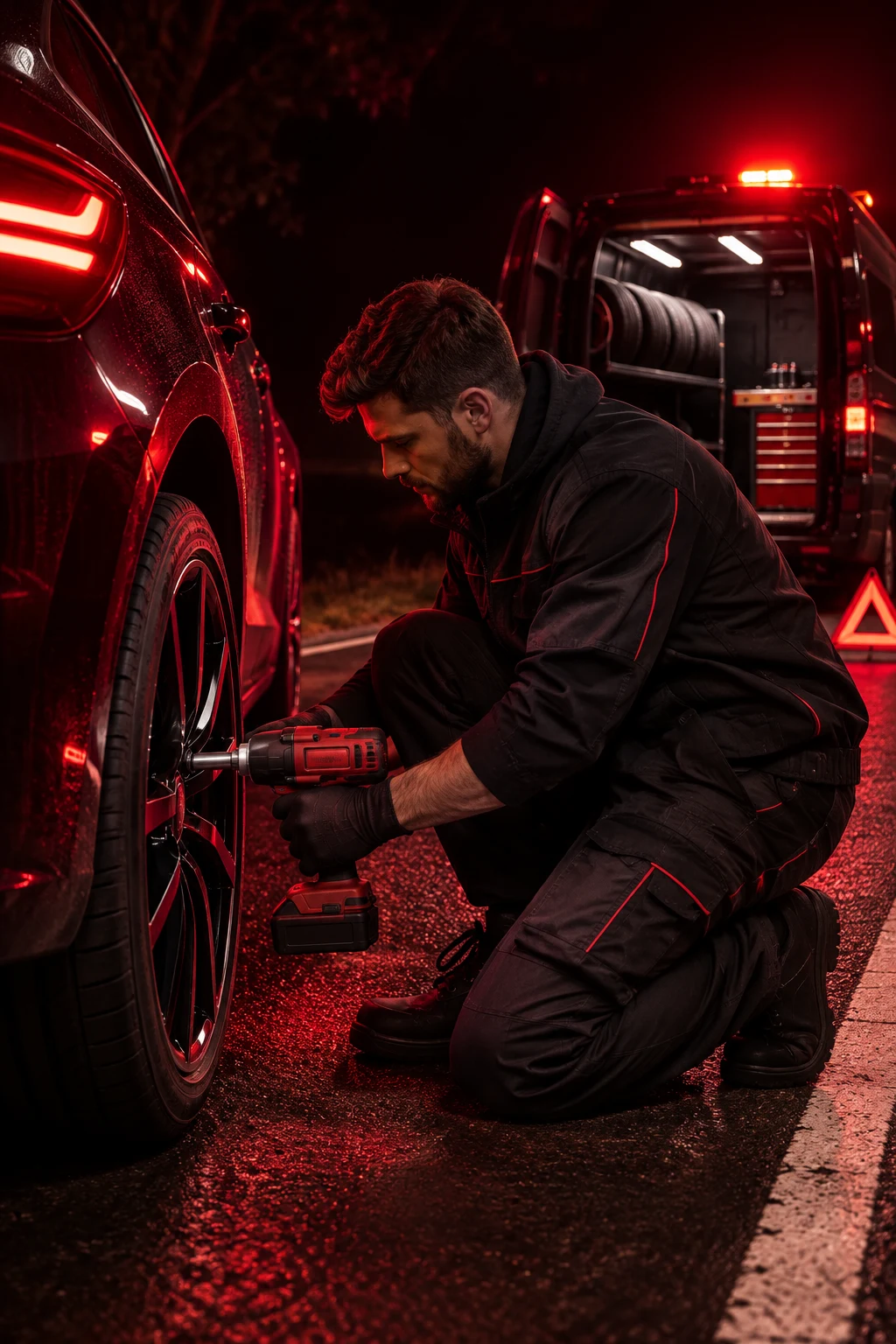
Once the car is somewhere safe – a service area, a junction lay-by, an industrial estate or a quiet side road just off the motorway – a mobile tyre fitter can come straight to you. There is no need to limp to a tyre centre on a space-saver or wait until the morning.
We regularly meet drivers at Yorkshire motorway services, including:
- Wetherby Services – A1(M) J46
- Ferrybridge – M62 / A1(M) J33
- Woolley Edge – M1 between J38 and J39
- Skelton Lake – M1 J45
- Hartshead Moor – M62 between J25 and J26
- Woodall – M1 between J30 and J31
- Doncaster North – M18 / M180 J5
- Leeming Bar – A1(M) J51
Send your location as a WhatsApp pin and tell us the tyre size. We agree a fixed price on the phone, and the van brings a new tyre, fits it, balances it and gets you back on the road.
Space-savers, sealant kits and run-flats
- Space-saver spare – a temporary wheel only. Most carry a maximum speed (often 50mph) printed on a sticker; check your handbook.
- Tyre sealant kit – may get you to safety with a small tread puncture, but it will not seal a sidewall cut or a blowout. Tell your fitter you have used sealant, as it has to be cleaned out before any repair.
- Run-flat tyres – usually allow around 50 miles at up to 50mph after a puncture. See run-flat tyres explained.
The Pennines in winter
The M62 crossing the Pennines near Saddleworth Moor is the highest stretch of motorway in England, and it can be cold, wet and windy when the rest of Yorkshire is mild. Standing on an exposed verge for an hour is miserable, so keep a warm coat, a torch, water and a charged phone in the car through the winter. Our guide to winter vs all-season tyres explains how the right tyres help on high roads.
How to avoid a flat tyre on the motorway
- Check pressures monthly and before long trips, when the tyres are cold. Under-inflated tyres overheat at motorway speeds – a common cause of blowouts.
- Look at the tread and sidewalls for cuts, bulges and screws. A bulge means the internal structure is damaged and the tyre must be replaced.
- Keep within the legal tread depth – and ideally replace at around 3mm. See legal tyre tread depth in the UK.
- Do not overload the car – heavy loads and caravans need the higher pressures listed in your handbook.
- Deal with slow punctures early – a nail in the tread can often be repaired cheaply. Read can my puncture be repaired?
Need a mobile tyre fitter now?
Once you and your passengers are safe, call 07000 000 000 or send your location on WhatsApp. We cover the M1, M62, M18, M180, M606, M621 and A1(M) corridors across Yorkshire, 24 hours a day, with a target arrival of around 60 minutes. See our mobile tyre services for everything we can do at the roadside.